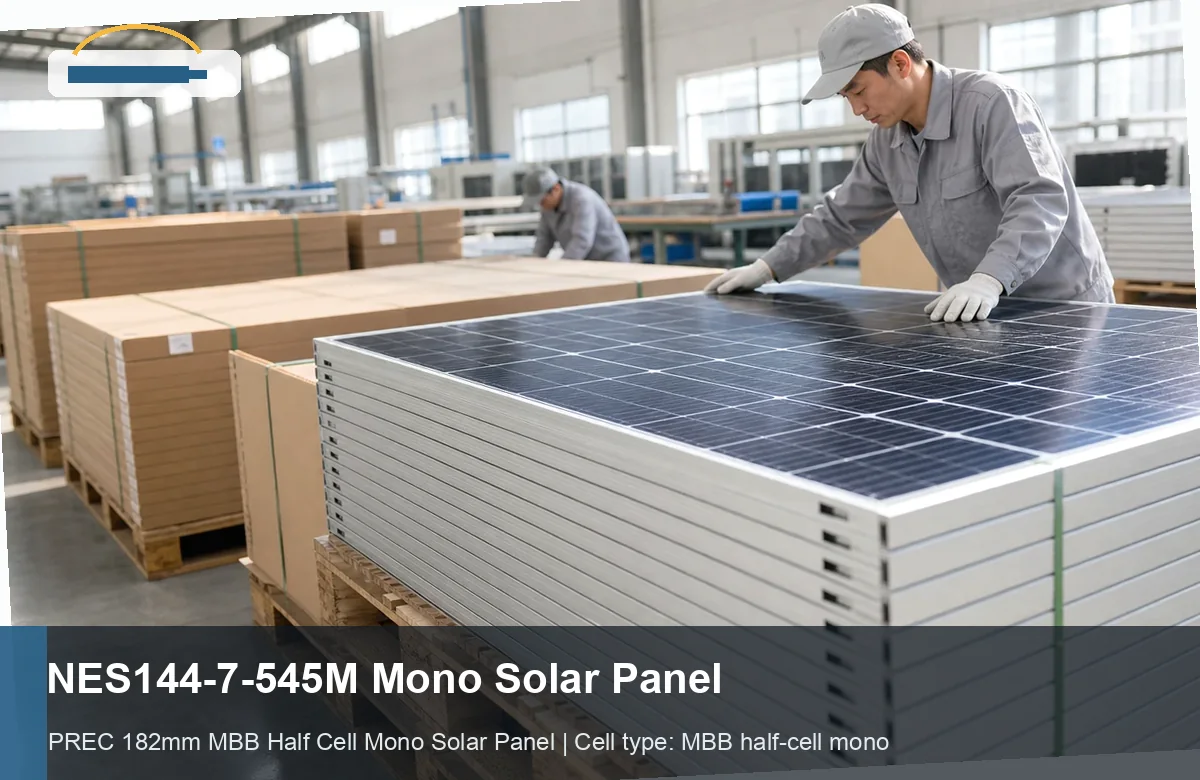
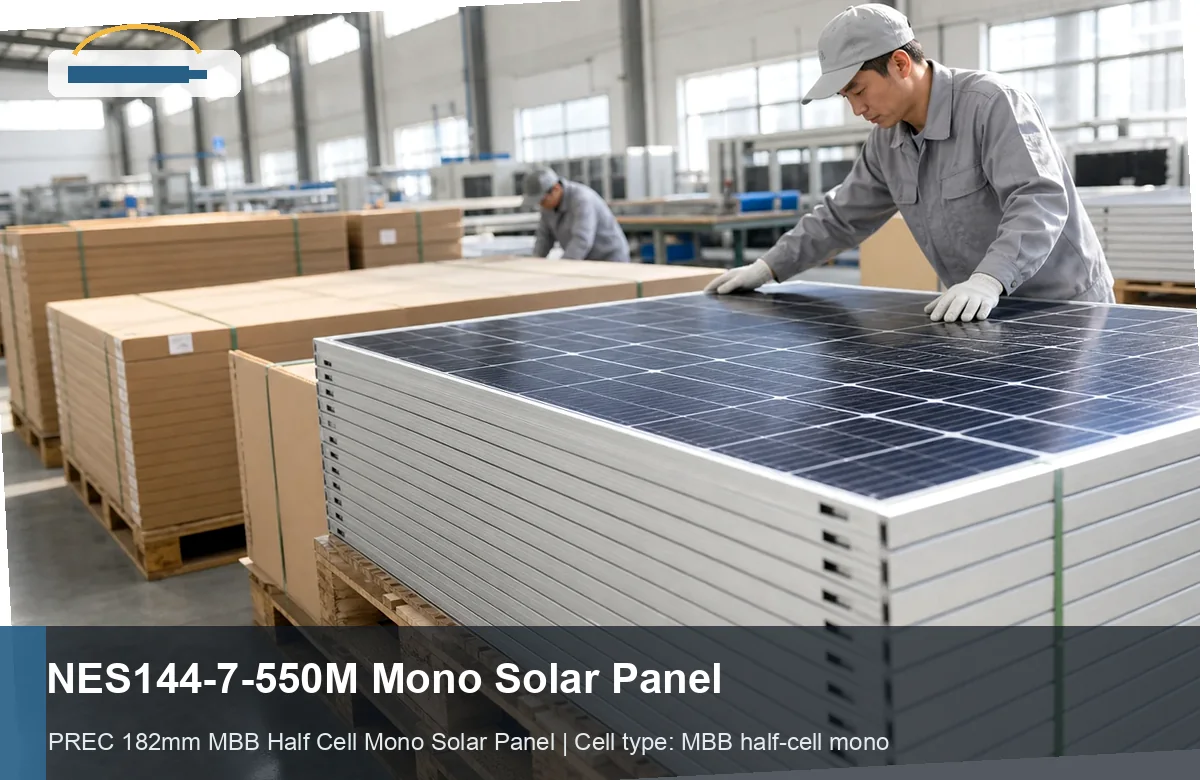
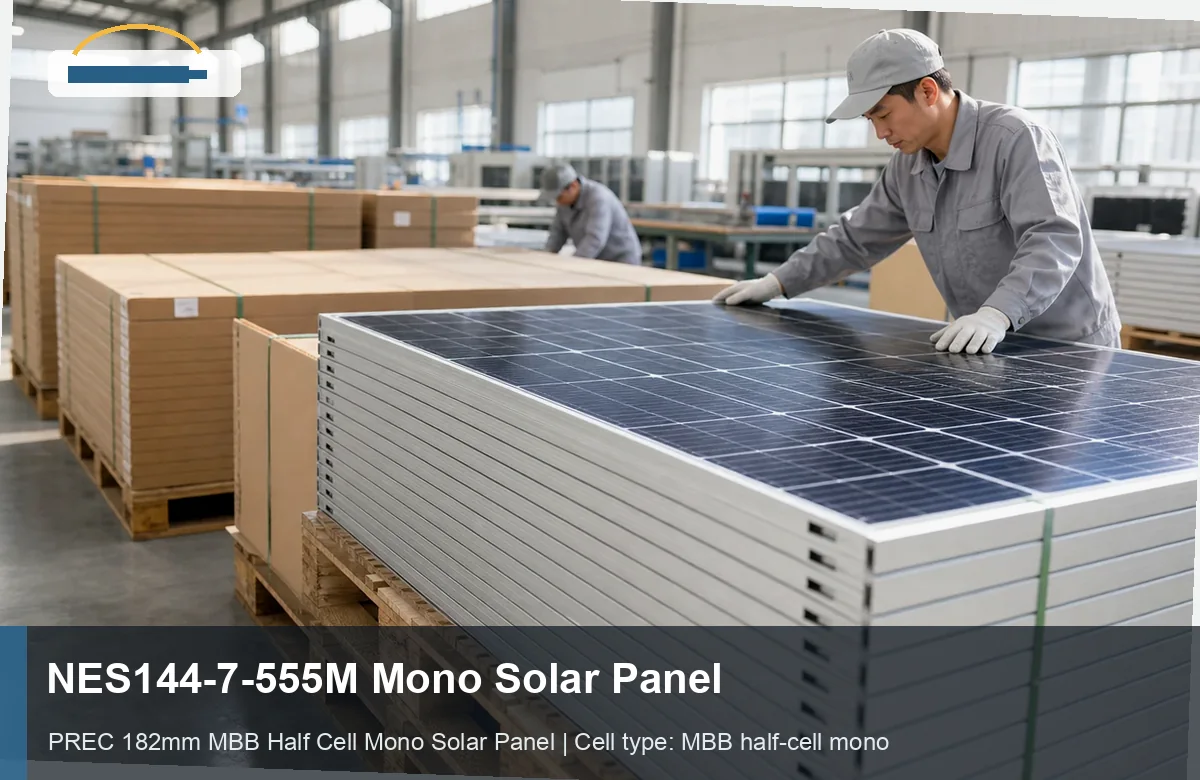
What the 545 to 555W band means for your project
The three NES144-7 variants differ by 10W steps and fractional efficiency points. In a 100-panel array, choosing 555W over 545W adds roughly 1kWp of rated capacity with zero change in installation labour, racking hardware, or cable routing, because pallet count, lifts, and frame footprint are identical across all three. The practical reason to pick within the band comes from how your inverter handles combined string Voc at cold temperatures: Voc rises as temperature drops, so the 555W panel's 50.02V produces a higher cold-temperature string voltage than the 545W panel's 49.75V. In most residential and light-commercial designs the difference is negligible, but check it against your inverter's absolute maximum input voltage before specifying.
- Same physical module for all three power classes: no racking changes between 545W, 550W, and 555W.
- Efficiency steps: 21.09% (545W), 21.28% (550W), 21.48% (555W).
- Voc steps: 49.75V, 49.90V, 50.02V. Vmp steps: 41.80V, 41.96V, 42.11V.
- System voltage rating is 1500V DC, matching modern commercial string inverter inputs.
Reading the electrical spec sheet for string sizing
Four numbers drive string and inverter sizing: Voc, Vmp, Isc, and Imp. Voc (open-circuit voltage) sets the maximum string voltage at the coldest expected temperature. Vmp (voltage at maximum power) must stay inside the inverter MPPT window throughout the day. Isc (short-circuit current) is the maximum current the module produces and sizes DC fuses and cable. Imp is the operating current at peak power. For the NES144-7-550M the values are Vmp 41.96V, Imp 13.11A, Voc 49.90V, Isc 14.00A. A 20-panel string of 550W panels produces a nominal string Vmp of about 839V and a string Voc near 998V; a cold-temperature correction pushes that string Voc higher, so check the temperature coefficient from the full datasheet before finalising string count.
- Voc times module count = maximum string voltage; keep it below the inverter's absolute maximum DC input.
- Vmp times module count = MPPT tracking voltage; keep it inside the inverter MPPT range across temperatures.
- Isc determines DC-side fuse and cable rating.
- All three variants run on a 1500V system rating, giving headroom for long strings in commercial ground mount.
- Request temperature coefficients from sales before submitting a design to a structural or electrical engineer.
Logistics: what 2279 x 1134 mm and 28.6 kg mean in practice
Each NES144-7 panel is 2279 mm long, 1134 mm wide, 35 mm thick, and 28.6 kg plus or minus 3%. These numbers drive your container load plan, lift equipment, and on-site handling. A single module at 28.6 kg is two-person territory for safe manual handling, and most procedures require mechanical assistance for rooftop lifts above a certain height. Container packing (pallet layer count, gross pallet weight, units per 20ft or 40ft container) should be confirmed with sales at inquiry, as those variables decide your freight cost per watt. If your project is moving toward bulk, discuss container and pallet planning directly with sales, who can advise on standard packing for the NES144-7 family.
- Panel dimensions: 2279 x 1134 x 35 mm; 35 mm frame suits most commercial racking clamps.
- Weight 28.6 kg +/-3%; budget about 29.5 kg per panel for conservative load calculations.
- Confirm the structural engineer has exact module weight and dimensions before the roof loading assessment.
- Confirm container load planning with sales at inquiry, including pallet height and layer count.
NES144-7 vs NES132: when to choose the smaller family
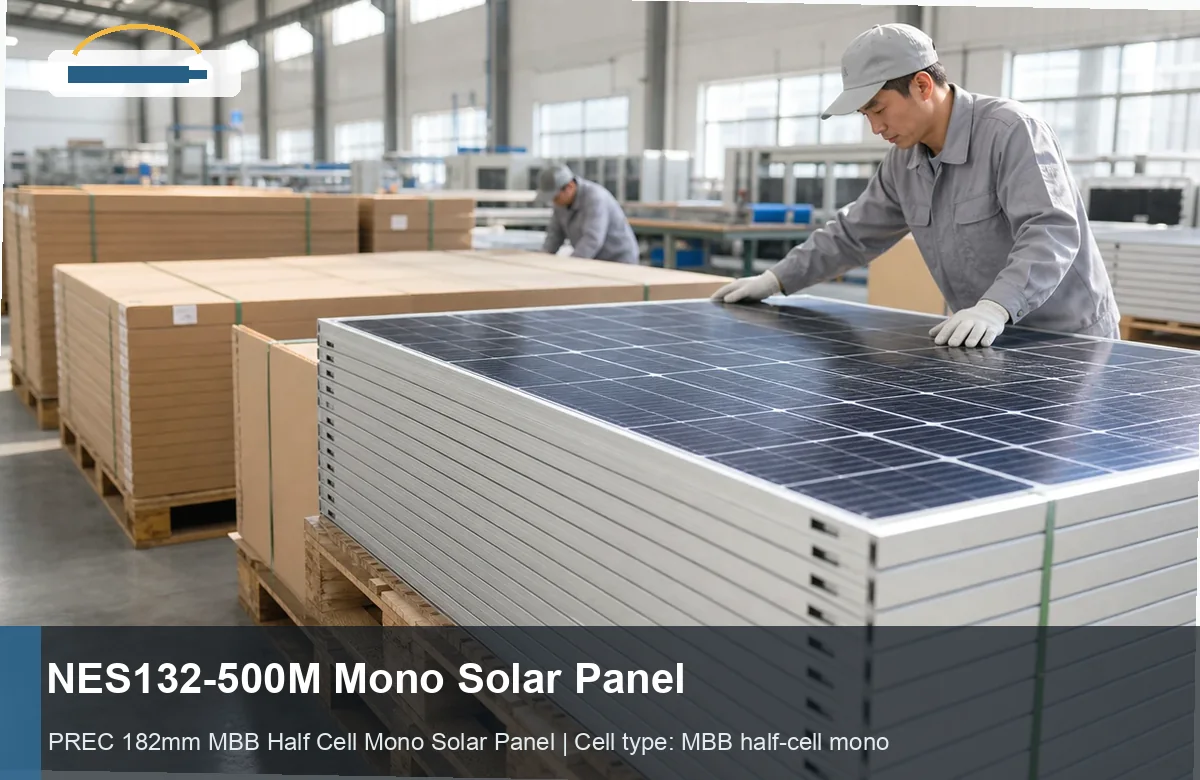
The NES132 family runs from 480W to 505W and is more compact than the NES144-7. It is relevant in three situations: rooftop layouts with shorter rafter spans where a 2279 mm panel exceeds the available run; structural calculations where a lower module weight is needed; and residential packages where the lower Voc of a smaller class simplifies string design for inverters with a lower DC input limit. If your project accommodates the NES144-7 format and your inverter handles the string voltage, the higher power class gives more watts per module with the same logistics footprint. If physical constraints are tight, the NES132 is the more practical choice. Confirm exact NES132 per-SKU dimensions and electrical specs with sales, as the catalog entry does not list per-SKU electrical parameters for that family.
- NES132 family: 480W to 505W; NES132-500M is the mid-range option.
- Use NES132 when rafter length, roof loading, or inverter DC input limits make NES144-7 impractical.
- Use NES144-7 (545 to 555W) when the layout accommodates the full 2279 mm length.
- Both families share certification: TUV, CE, CQC, SGS, INMETRO, DEKRA, ISO9001, ISO14001, ISO45001.
Certifications by destination market
The NES144-7 and NES132 families carry ISO9001, ISO14001, ISO45001, TUV, CE, CQC, SGS, INMETRO, and DEKRA. CE covers EU and UK-adjacent imports; INMETRO is required for Brazil; CQC is relevant for Chinese and some regional programs; TUV is a globally recognised independent test that supports utility and project-finance requirements; SGS and DEKRA are independent test and certification bodies whose reports are accepted by many developers and grid operators. When building a quotation for a specific market, ask sales to confirm which certificates are currently valid for the modules in your order and to provide copies for submission to your local authority or project developer.
- CE: required for EU and most UK-equivalent imports.
- TUV: widely accepted by project developers and grid operators globally.
- INMETRO: required for Brazil.
- SGS and DEKRA: independent lab reports accepted in many tender and finance processes.
- Ask sales for current certificate copies before submitting to your authority, grid operator, or lender.
Building your bulk RFQ
A structured inquiry gets faster, firmer pricing. Include the specific model or models (for example NES144-7-550M), total quantity by SKU, destination country and port, required certifications, the delivery window, any packaging or labelling such as OEM or private-label marks, and whether you need technical documentation for grid connection or project finance. If you are comparing NES144-7 and NES132 in the same project, request both datasheets and packing specifications so you can run the logistics comparison before committing. For bulk orders, sales can advise on standard packing, container fill, and the relationship between order quantity and lead time; container and pallet planning belongs at the RFQ stage, not after the purchase order. MOQ is quoted by project for these families, so include your full project scope in the first message.
- Include model, quantity, destination, certifications, delivery window, and packaging requirements.
- For structural and grid documentation, request the full datasheet including temperature coefficients.
- For container planning, ask for pallet configuration and gross weight per pallet at your target quantity.
- Confirm OEM and private-label options and minimums during the RFQ, not after.
- MOQ is quote by project; share project details so sales can confirm minimum quantities.