Balcony Solar System / Balcony Solar System
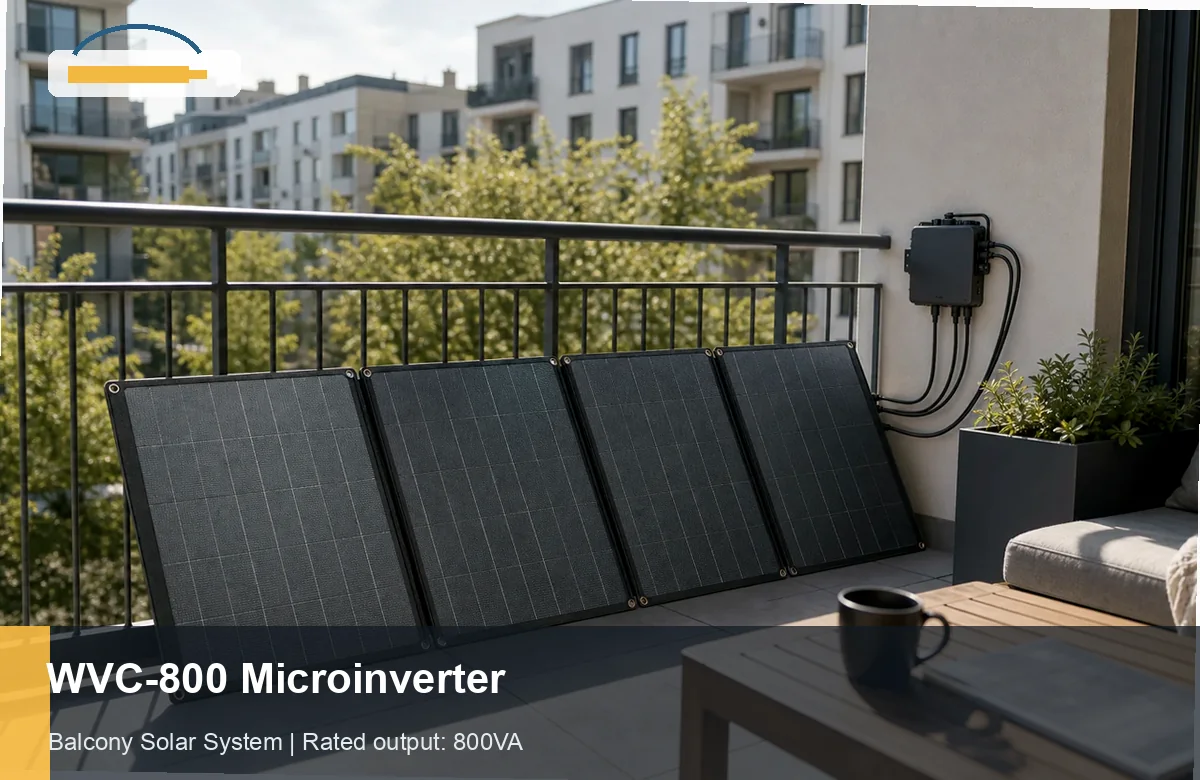
WVC-800 Microinverter
WiFi-enabled 800VA microinverter for balcony solar and small residential PV packages.
Rated output800VAMax input power2 x 500WMPPT voltage30-60V
 Spire ESSOEM clean-energy sourcing
Balcony solar sourcing
How EU distributors source complete balcony solar kits: panels, microinverter, bracket, monitoring, and plug-in cable as one package.
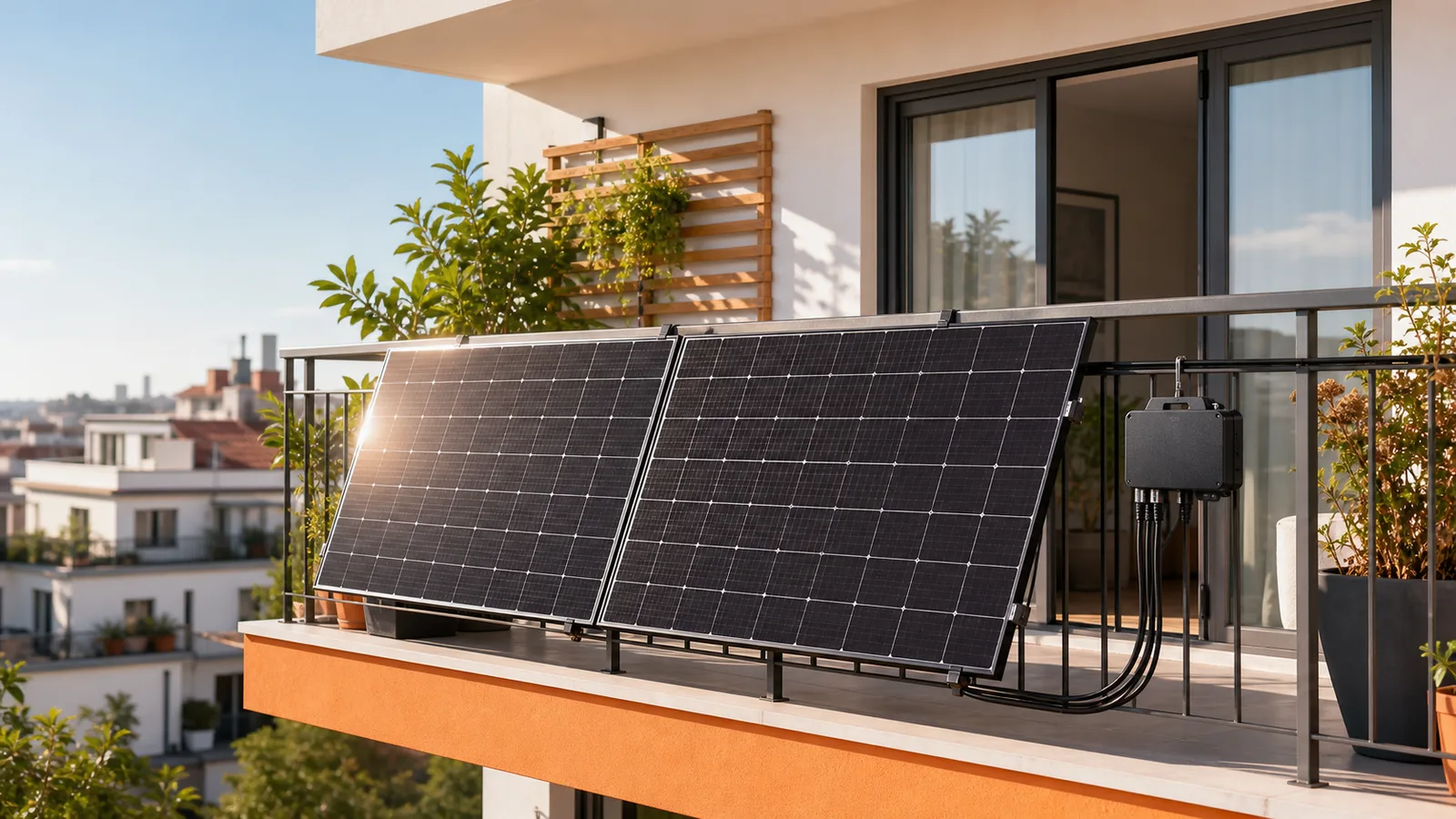
Balcony solar has moved from a niche product into a mainstream retail line in several EU markets. Apartment residents and renters want to generate their own electricity without a rooftop installation, and a compact plug-in kit gives them a practical path. For a distributor, the opportunity is not just selling a panel; it is selling a complete, shelf-ready system that a non-technical buyer can install on a balcony railing or wall in an afternoon. That shift from panel-only to kit-based sourcing changes what you specify, how you package, and how you build your RFQ.
This guide walks through what a balcony solar kit contains, how to size a common EU configuration, the packaging and compliance considerations that affect cross-border shipment, and how to structure a supplier conversation that gets you a real, comparable quote. All component specs are drawn from the Spire ESS catalog. Where local rules vary by country, this guide flags the question and recommends confirming with sales and your local compliance contact before finalising any configuration.
What to decide before asking for price.
A balcony solar kit is sold as a package but assembled from four or five components that each need correct specification. Getting one wrong, for example a microinverter whose MPPT range does not match the panel's operating voltage, means the system underperforms or does not work.
The core components are:
The most widely requested EU configuration is two panels with a single microinverter.
For a lighter, more portable configuration (seasonal use, or an add-on to a camping setup) the XC200W foldable panel (200W, monocrystalline, ETFE/PET) can pair with a lower-wattage inverter. It is not the primary balcony product but appears here because it is sometimes used as a flexible supplementary panel; confirm any foldable pairing with sales. A standard balcony kit is a grid-feed system with no storage: the microinverter feeds power into the apartment circuit at the moment of generation. If the customer wants to store surplus, that is a separate product category.
The regulatory environment for small plug-in PV is not uniform across EU member states. Some countries have simplified frameworks that allow direct socket connection up to certain output thresholds; others apply general grid-connection rules requiring notification to the local network operator regardless of size.
This guide does not state specific national rules as fact because they change and vary in detail. At the sourcing stage, what matters is:
The practical recommendation is to identify your top two or three target markets, map the specific rules for each before writing the specification, and build the kit to the strictest set of requirements if you want a single SKU to work across markets.
Balcony kits have packaging needs that differ from selling panels as pallet freight: the package must protect contents through last-mile delivery, communicate to the end buyer, and meet the weight and dimension limits of your fulfilment operation.
The YH410W-27MH panel is packaged as a two-unit set at 1872 x 1172 x 135 mm and 73 kg gross. That is a large, heavy carton; for B2C or e-commerce, 73 kg is at the upper limit of standard parcel carriers and many require pallet delivery or two-person handling. Buyers sourcing for e-commerce should discuss disaggregated packaging (panels and inverter in separate cartons assembled on site) during the RFQ.
Questions to address with the supplier:
For e-commerce, the product page and carton label should reflect the plug-in compliance status for the destination market; build that documentation requirement into your sourcing brief.
A structured RFQ gets a faster, more comparable response. Cover:
Several aspects cannot be resolved from the catalog alone:
| Component | Role | Catalog | Key spec |
|---|---|---|---|
| Solar panel x2 | DC power generation | YH410W-27MH Balcony Solar Panel | 410W each, Vmp 31.46V, 1722 x 1134 x 35 mm, CE |
| Microinverter x1 | DC to AC, grid feed | WVC-800 Microinverter | 800VA, 2 x 500W max input, MPPT 30-60V, 92.7% peak, 5-yr warranty, CE |
| Mounting bracket x1 | Panel attachment to railing or wall | Included with YH410W-27MH package | 1860 x 1160 x 53 mm; confirm bracket type per market |
| Plug-in cable x1 | Microinverter AC output to circuit | Confirm with sales | Connector standard and cable spec vary by country; confirm local plug-in rules |
| Monitoring module | Generation tracking via app | WVC-800 WiFi monitoring | Confirm app availability and access for target market with sales |
Example configuration based on catalog specs. Final component selection, cable assembly standard, bracket variant, and kit-level pricing must be confirmed with sales. Local plug-in and grid-connection rules vary by EU country and must be verified with your local compliance contact before launch.
Products
Balcony Solar System / Balcony Solar System
WiFi-enabled 800VA microinverter for balcony solar and small residential PV packages.
Balcony Solar System / Balcony Solar System
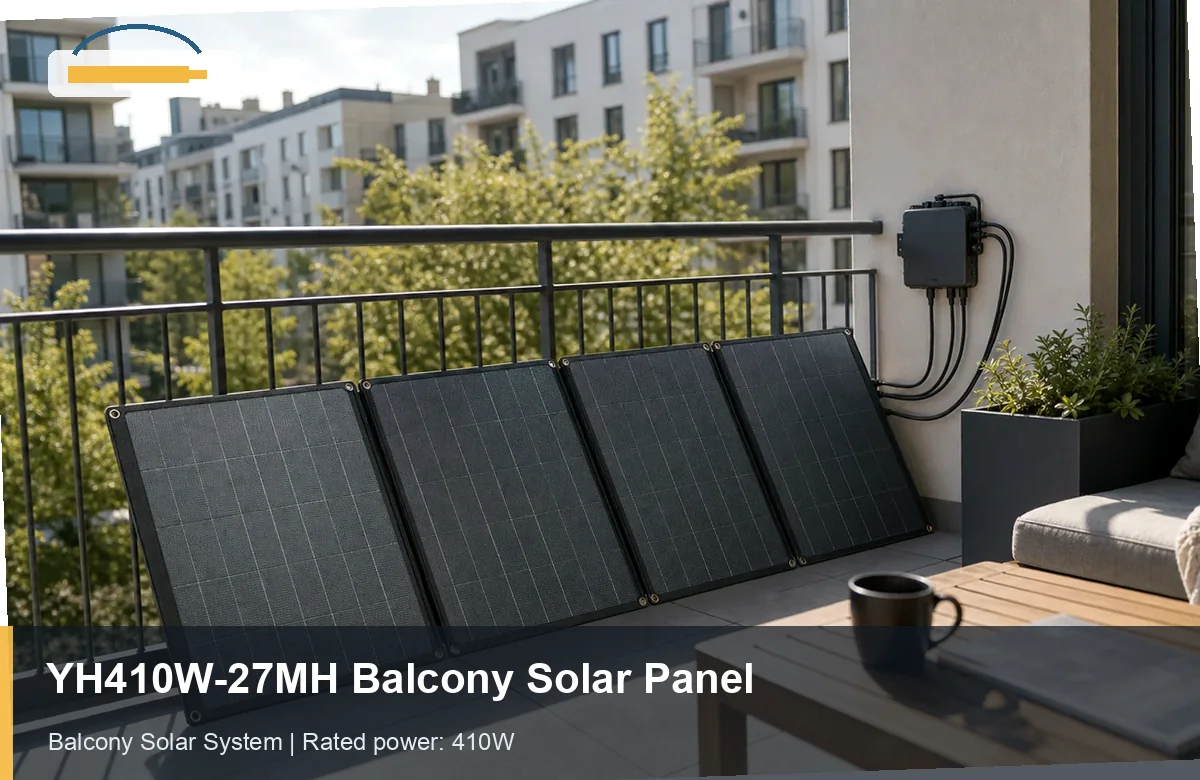
410W mono panel specified for balcony solar package configurations.
Foldable Solar Panels / XC Foldable Solar Charger
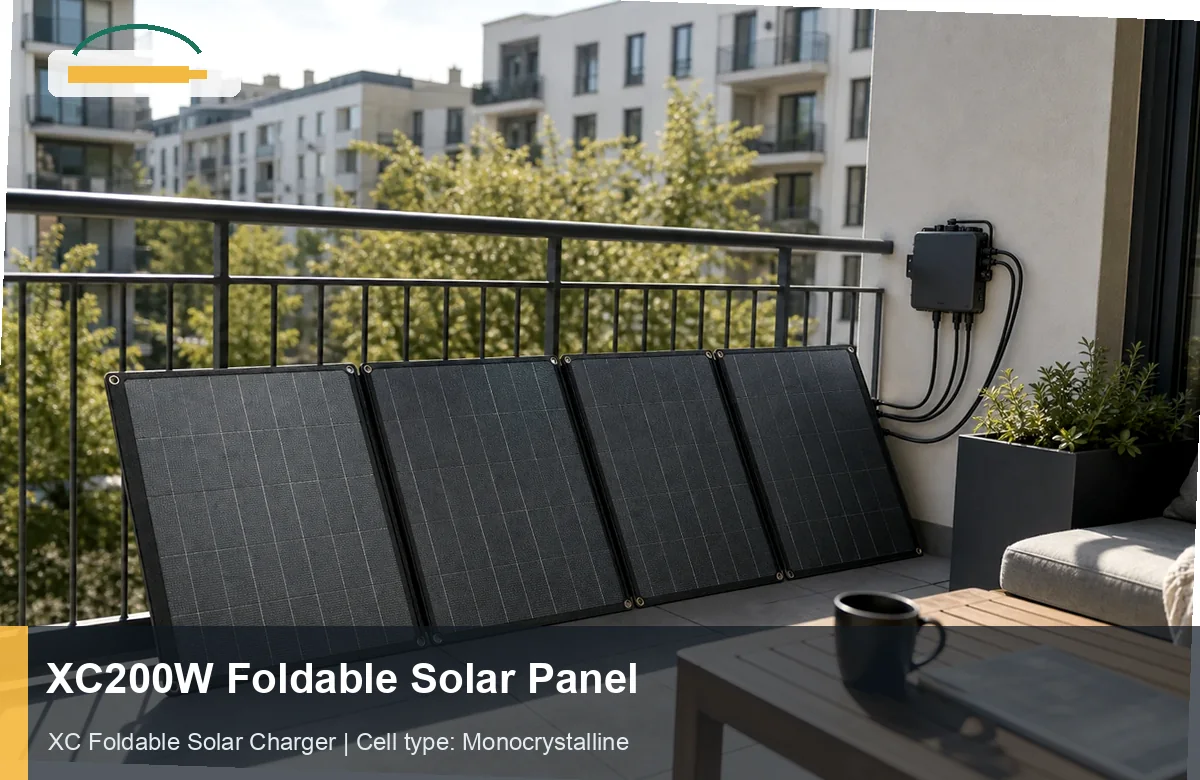
Foldable solar charging panel for camping, RV, hiking, and portable power station charging.
Yes, based on catalog specs. The WVC-800 accepts up to 2 x 500W of panel input with a 30 to 60V MPPT range; the YH410W-27MH has a 31.46V Vmp, within range. Combined STC output of two 410W panels is 820W and the microinverter's rated AC output is 800VA. Confirm the final configuration with sales, particularly for markets with specific microinverter approval requirements.
A standard kit covers panel, microinverter, bracket, and connection cable. Whether all arrive in one retail carton depends on the supplier's packaging; confirm during the RFQ. Typically not included: installation tools, any required energy meter, and market-specific grid-notification documentation. Check what your market requires and add those items to the kit spec or an accessory offering.
The YH410W-27MH ships as a two-unit set at 73 kg gross, 1872 x 1172 x 135 mm. That weight typically requires pallet delivery or two-person handling and exceeds standard parcel limits in most EU countries. For e-commerce, discuss disaggregated packaging with sales and confirm the logistics cost impact before finalising the kit format.
Yes, and they vary. Some EU countries have simplified notification processes for small plug-in PV; others apply standard grid-connection procedures regardless of size. This guide does not state specific national rules as fact because they change. Confirm local plug-in rules per market with your compliance contact and discuss microinverter approval status with sales before finalising.
The XC200W is a 200W monocrystalline foldable panel with an ETFE/PET surface, designed mainly for portable and outdoor use. It can serve as a supplementary or flexible panel in some configurations, but the standard balcony kit uses the rigid YH410W-27MH. For a rental or seasonal-use kit, confirm the microinverter pairing and bracket solution with sales before specifying.
State the complete bill of materials explicitly (panel model and quantity, microinverter, bracket, cable assembly, monitoring, packaging format), plus target market, certifications, quantity tiers, carton limits, and delivery window, and ask specifically for a kit-level unit price including packaging and assembly. A clear BOM reduces back-and-forth and gives a comparable quote.
AI product assistant